Amanita eliae is an inedible[1] species of fungi in the family of Amanitaceae found in Europe. It was described by Lucien Quélet in 1872.[2] Synonyms include Amanitaria eliae, Amanita godeyi, and Amanita cordae.
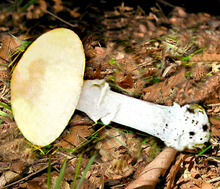


Description
Its cap is 8 to 10 centimetres (3.1 to 3.9 in)[3] or 10 to 15 centimetres (3.9 to 5.9 in)[dubious ] in diameter[4] and 6 to 10 centimetres (2.4 to 3.9 in) across. It has a white volva.[1] Its warts correspond to easily removable, deep depressions in the cap of the species.[3] Its stem is around 8 to 12 centimetres (3.1 to 4.7 in) tall and has a diameter of 0.8 to 1.2 centimetres (0.31 to 0.47 in);[1] it is subcylindric and tapers upwards. The cap and stem have white flesh.[1][5] The stem is initially entirely white, but browns with age with a narrow bulb.[6] The stem ring is white.[1] Its stem is smooth and has white gills on the hymenium.[4] Its odour and taste are indistinct.[1][4]
Habitat
It is commonly found coniferous and deciduous trees.[3] It is found in the autumn and summer.[4]
| This article uses material from the Wikipedia article Metasyntactic variable, which is released under the Creative Commons Attribution-ShareAlike 3.0 Unported License. |